RumorGuard
What is Rumor Guard?
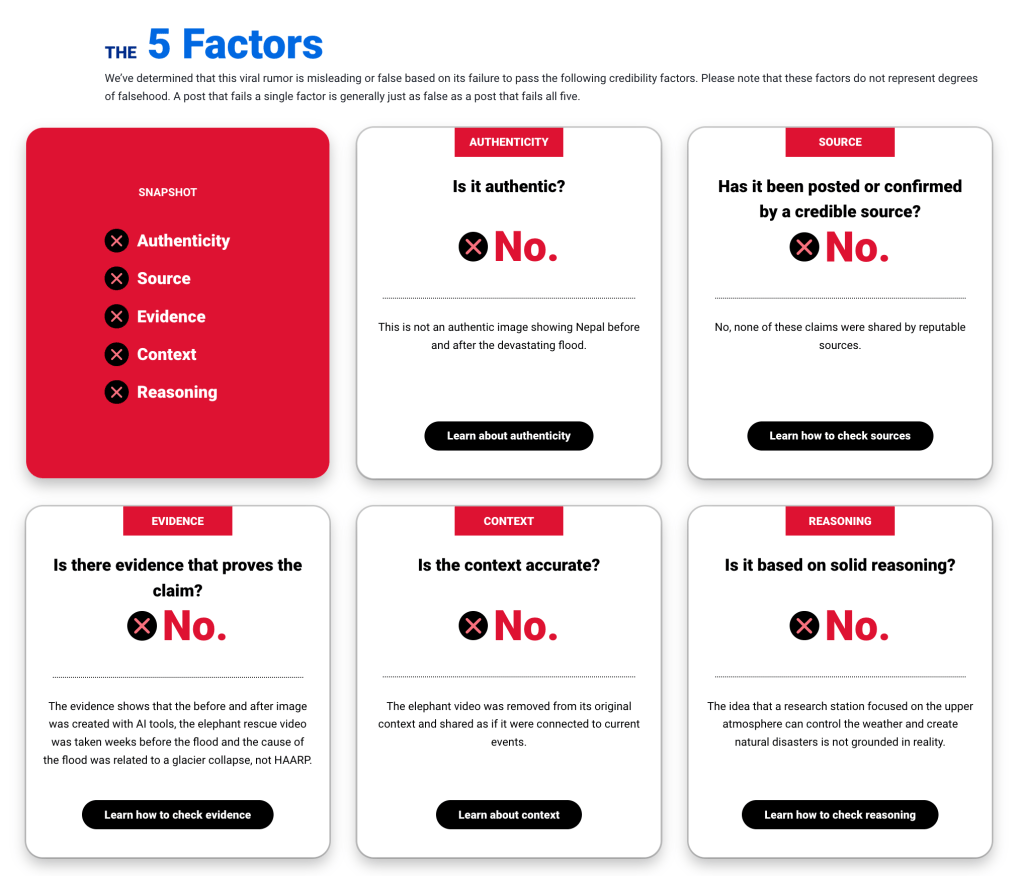
RumorGuard by the News Literacy Project is a platform fact-checking viral media, similar to Snopes or Politifact. Unlike the other platforms, RumorGuard’s paradigm evaluates news and media with five specific factors: authenticity, source, evidence, context and reasoning with different avenues to learn more about the lesson and techniques used to affirm the evaluation.
RumorGuard also has takeaways in each evaluation, providing readers tips and standard procedures on consuming news and media with greater literacy.
Educational Effectiveness
RumorGuard can be effective, dealing with the interventions set aside by the American Psychological Association, including debunking, prebunking, literacy training and nudging. RumorGuard does not only debunk viral, controversial moments in news and media. The platform provides a procedure in encountering with similar media, including AI-generated content. These procedures strengthen a viewer’s media literacy. However, the effectiveness of RumorGuard can be somewhat dubious despite the framework provided, because many people who may be deceived may not question it. Nevertheless, the platform is effective in training media literacy and consumption to those who seek it.
Looking Forward
I think platforms like RumorGuard, as well as other fact-checking platforms like Snopes and Politifact, are incredibly helpful in disseminating truthfulness in misguided conversations online. They are sharable, accessible and easy to digest, making it very useful for media literate individuals to combat misinformation they see on social media or anywhere else.
Bad News
What is Bad News?
Bad News is an educational game where the player learns manipulation techniques bad actors utilize to gain influence by sharing misinformation. Techniques include impersonation, emotion, polarization, conspiracy, discredit and conspiracy.
Players must reject their own sensibilities and publish viral media, utilizing these techniques, affirming conspiracy and distrust against large institutions. Players go through a simulated social media platform and click through a couple of options on developing and publishing harmful content. This game aligns with prebunking, an educational intervention listed by the American Psychological Association as an effective tool against misinformation. The reference can be seen hyperlinked in the section above.
Educational Effectiveness
Bad News teaching players the techniques used and characteristics of the publication of misinformation is noble; however, the efficacy of its purposes is somewhat dubious.
According to a study investigating long-term impact of misinformation interventions among high school students, the game Bad News did not “significantly [improve] students’ ability to evaluate credible and misleading news.” The study affirms the necessity of sustainable training and engagement with credible news. Bad News, in its vacuum, does not provide meaningful behavioral changes to players.
Looking Forward
I agree with the study. Sustainability is necessary. Bad News is a fun, interesting game teaching players about manipulation tactics on social media, furthering inoculation intervention. However, it does not yield long-term effects. As techniques and tools evolve in spreading misinformation and distrust toward our institutions, then Bad News will continue to be inadequate in teaching individuals on how to consume news and media.
 Paul Pascual
Leave a comment